HOME
TOPICS
ABOUT ME
Scan those certificates you get when you complete a training course or get an award at school, then print them out at a much smaller size.
Al Fasoldt's reviews and commentaries, continuously available online since 1983
T e c h n o f i l
e
Image is everything, Part 3: Having fun with your
scanner
Jan. 19, 2003
By Al Fasoldt
Copyright © 2003, Al Fasoldt
Copyright © 2003, The Post-Standard
I can't give away ALL my secrets, but I'll tell you one that gets 'em every time.
When I'm giving a talk on digital photography and scanning to a civic group or computer club, I pass around a stunning photo, made quite large, of a painted figurine. I tell everybody a sad story about how much I had to pay to get such a detailed picture.
The figurine was selected from my wife's collection of doll-house figures. It's a beautifull example of old-fashioned craft art.
My "sad story" is totally made up. I tell them a tall tale. No ordinary camera could possbly take a picture so detailed and accurate in all its colors and subtleties, I say, trying hard to fool everyone. I tell them I had to take the figurine to a professional shop where it could be photographed by a $30,000 Swiss-made camera.
When I hold up the photo and pass it around again, empasizing the prohibitive expense of getting such an astonishing print, most people sit there and nod in agreement. After all, we all seem to believe now and then that good things just have to cost a lot of money.
And that's when I 'fess up. I tell everyone the big blowup of Nancy's figurine cost me 40 cents. That's what I pay for a single sheet of photo-quality inkjet paper. The Swiss-made camera? No such thing.
Then how did I do it?
I scanned the figurine on my $80 flatbed scanner. I merely placed the little figure on the glass, covered it with a hand towel to keep the light from scattering and hit the scanner button. Then I printed the scan on my inkjet printer.
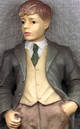 You can
see the scanned image of the figurine in the picture
accompanying this article. It's sharp, clear and
stunningly real, with a 3D look.
You can
see the scanned image of the figurine in the picture
accompanying this article. It's sharp, clear and
stunningly real, with a 3D look.Can an ordinary flatbed scanner do this? It sure can. Can it do it well? It can take pictures of small objects better than most cameras can. If you have a scanner, try it and you'll see.
But don't stop at figurines. You can have fun with your scanner in other ways, too. Here are some suggestions:
Do what I did for the holidays if you have grown children: Scan their old school report cards and homework projects, then print them out on art paper or heavy stock as birthday or holiday gifts. My kids have children of their own, so I had a joyful time scanning school artwork from the late '60s so that my grandchildren could see what their parents were doing in first and second grade.
If your kids are still young, scan their hands every three months or so and save all the scans so they can be used as clever timeline art. An added idea: Make multiple copies of the best handprints and arrange them in a pattern that looks like a picture frame. Then frame your kids' pictures with their own handprints.
Scan your coin collection. You can scan coins (and other small objects) one at a time as long as you crop the scan area in the scanner's preview window. (Scan the item, not the full background along with it.) Or you can scan many coins at once. The 3D effect will surprise your coin-collector friends when they see your scans.
Scan your stamps. There's nothing wrong with scanning stamps one at a time, and the resulting images will store easily if you name them properly. I suggest doing both group scans and individual scans.
Scan your CD album covers. If you (or your kids) know how to turn images into icons, the scanned album covers can be used as icons for MP3 versions of the CDs. (If that's not cool, my name is Mr. Bill and you are a peacock.)
Scan your keys. Scan both sides. If your keys get lost and you don't have duplicates, a locksmith might be able to create new keys by examining your scans. (But store the scans where they won't get stolen.)
Scan those certificates you get when you complete a training course or get an award at school, then print them out at a much smaller size (maybe 4 inches by 5 inches) and frame them for your desk. They take up less space and look -- dare I say this again? -- really cool.